
In biblical history, the promises made to David stand as a testament to enduring hope and spiritual legacy. This story threads through time, weaving ancient prophecies with the fulfillment found in Jesus Christ, creating a vision of a kingdom that transcends earthly boundaries.
Royal Lineage and God's Promise
In 2 Samuel 7:12-13, God's promise to David ensures his legacy through a royal lineage. This promise takes root in David's offspring, extending through time. It assures David that his lineage would stand for eternity—a promise strong and unyielding. Solomon, David's immediate heir, begins this role by building a physical temple for God.
However, God's plans extend beyond immediate descendants, setting sights on an unending kingdom with spiritual undertones. The connection between David's line and Jesus opens the door to a spiritual domain—a kingdom of the heart.
Messianic hopes remain consistent, pointing to a descendant who would fulfill the covenant beyond immediate understanding. In the New Testament, Jesus, descended from David, emerges as the chosen inheritor of this eternal promise, establishing an everlasting spiritual kingdom.
This Messianic fulfillment becomes a cornerstone of hope, extending beyond the Israelites or a single building. It envisions a kingdom marked by open hearts and kind souls. Followers find reassurance and strength in this unfolding prophecy, assured that through faith, they too are part of an enduring reign guided by divine wisdom.
The future kingdom promise offers more than solace. It paints an optimistic picture of peace and justice, ushered in by an eternal King whose reign knows no end. This kingdom, though invisible, is evident in every act of kindness and echo of love. It's a domain defined by devotion and spiritual adherence, where life can be fuller, richer, and more purposeful.

Messianic Fulfillment in Jesus Christ
The New Testament transforms David's lineage into a profound fulfillment through Jesus Christ. Jesus bridges the spiritual with the ancestral, His genealogical link to David carefully traced in the Gospels, particularly in Matthew 1:1 and Luke 3:31.
The wonder of Messianic fulfillment lies in the spiritual domain Jesus inaugurates. Through His life, teachings, sacrificial death, and resurrection, Jesus establishes a kingdom characterized by grace, truth, and love, offering every believer a role within this divine story.
This spiritual kingdom finds its foundation in Jesus' resurrection, which the early apostles heralded as evidence of His divine kingship and fulfillment of God's covenant. The resurrection signifies an eternal commencement of a kingdom where death holds no dominion.
Jesus stands as the cornerstone of faith, embodying the hope and promise bestowed upon David. The kingdom He forms reflects a dominion of righteousness, inviting believers to echo its values in their lives through acts of kindness and transformations of the heart.
Through Jesus, the prophecy to David becomes a living promise, reassuring believers of a future that holds divine significance—a kingdom where every tear is wiped away, every sorrow turns to joy, and faith gives rise to eternal life.
Future Kingdom Hope
The vision of a future kingdom in 2 Samuel 7 is a beacon of hope that resonates deeply with believers today. This promise provides assurance that the current struggles and injustices of the world are not the final word.
Both the Old and New Testaments consistently reaffirm this hope—a future reign characterized by peace, justice, and joy. The prophets Isaiah and Jeremiah spoke of a coming era where society would be transformed by divine justice. Isaiah paints vivid pictures of a renewed and redeemed landscape, both literal and metaphoric.
In the New Testament, Jesus invites followers to envision and embody the kingdom's principles in the present. He teaches that the kingdom of God is at hand, shaping reality through each act of love and faithfulness.
For believers today, this future kingdom hope serves as a guide through uncertainty and societal discord. It reassures them that their struggles are not in vain, as God's promise encompasses all of history. This vision of an eternal kingdom, where everlasting peace and joy flourish under Christ's kingship, encourages the faithful to live out its reality even now.
Every gesture of kindness and moment of compassion becomes a precursor to the ultimate peace that awaits. This hope invites believers to participate actively in realizing God's promise, living out faith that transforms both the world and themselves.
As believers look forward, they stand on firm ground, bolstered by the unfading promise of an eternal kingdom. This hope is not only a vision of what is to come but an invitation to live out the principles of that heavenly kingdom in the present, sparking transformation that ripples forward into eternity.

God's Covenants and Their Impact
God's covenants stand as divine commitments that illuminate the path of faith, offering believers tangible assurance of His steadfast character. These agreements between God and His people are living promises that dynamically shape the faith and life of believers.
From Noah to Abraham, Moses, and David, each covenant bears testimony to God's faithfulness and unwavering commitment to His creation. These covenants underscore not only His sovereignty but also His mercy, promising to guide, protect, and bless those who walk in His ways.
The impact of God's covenants on practical faith is significant. They remind believers that God's promises are eternally anchored in His character, transforming the way they handle life's challenges. This assurance acts as both a compass and a balm, steering them to righteousness while soothing their unease in life's uncertainties.
These covenants foster a communal identity among believers, reminding them of a collective heritage and shared destiny. This unifying force compels believers to act as stewards of His promises, bearing witness to His goodness through acts of kindness and compassion.
God's covenants invite believers to a proactive faith, challenging them to align their lives with His divine plan and become active participants in bringing about the fulfillment of these promises. This active engagement reflects a vibrant faith that puts belief into action.
In every season, these covenants serve as a reminder that God's love and mercy are truths to be lived. They call individuals to reflect on the transformative nature of God's promises, encouraging them to seek His face with humility and gratitude. As believers respond to these covenants, they are drawn into a deeper relationship with their Creator, fostering a faith that is both resilient and overflowing with hope.

Gentiles and the Davidic Covenant
The Davidic Covenant extends beyond God's chosen people to include Gentiles in its embrace. This divine inclusion demonstrates God's expansive vision, where the kingdom of David is destined to encompass a diverse array of cultures and nations, unified under Christ's reign.
In the New Testament, this universal scope comes to life. The Jerusalem Council, as recorded in Acts 15, grapples with the reality of the Gentiles' burgeoning faith. James' proclamation recognizes that God's eternal kingdom is a beacon of hope for all humanity.
This shift marks a profound expansion—opening the covenant doors to a global fellowship in Christ. The words of the prophet Amos, cited in the council's resolution, affirm that the restoration of David's fallen tent is linked to a worldwide call for all humanity to seek the Lord.
For the early church, this inclusivity reimagined the kingdom of God as a sphere where lineage, ethnicity, and previous exclusions have no hold. Jesus Christ, the Son of David, emerges as the linchpin of this divine promise—a Savior whose love encompasses the world, transcending once insurmountable divisions.
This universal reign of Christ provides a practical blueprint for the church today. It calls believers to live out their faith in a manner that echoes this inclusivity, embracing a spirit of unity that reflects the heart of the Davidic promise. The church is now a vibrant, global body, reflecting the rich diversity of God's creation, unified under Christ's eternal kingship.
Understanding their inclusion in the Davidic Covenant, Gentiles are called to actively participate in the kingdom's mission—spreading the message of grace to every nation, tribe, and tongue. This is a kingdom where barriers crumble and the church, in its diversity, stands as a living testament to God's enduring covenant.
In embracing this promise, believers find a shared mission that transcends cultural lines, engendering a community built on love, grace, and acceptance. The church continues the legacy of David not by conquest, but by witness—shining Christ's light into the farthest reaches, drawing every heart to the throne of grace.
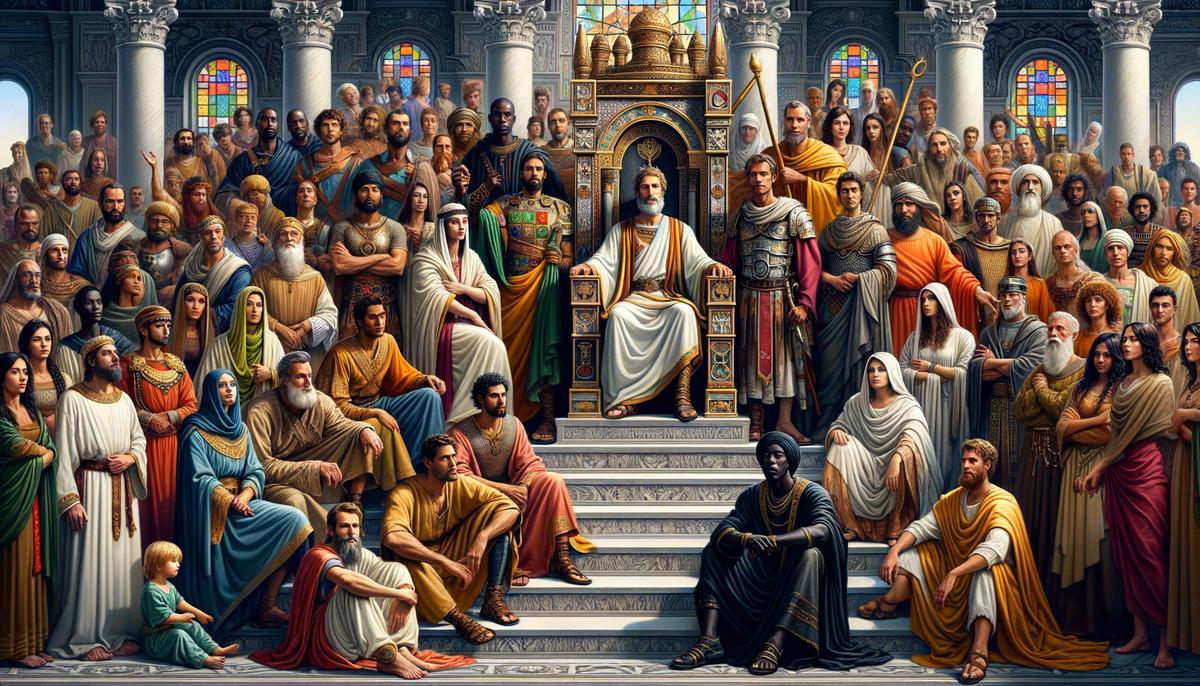
The enduring promise to David finds its ultimate expression in the all-encompassing reign of Jesus Christ. This vision of a kingdom invites all humanity into a sphere of peace and righteousness, offering a beacon of hope that shines brightly through the ages.
- Piper J. The reason God's covenants with Noah, Abraham, Moses, and David ought to increase the joy of our faith. Desiring God. 1982.
- The Holy Bible, New International Version. Zondervan. 2011.
- Acts of the Apostles. In: The New Oxford Annotated Bible. Oxford University Press. 2010.