
Historical Context of Isaiah 7:14
King Ahaz of Judah faced a difficult political situation in the 8th century BC. The Assyrian Empire threatened from the northeast, while Israel and Syria pressured Judah to join their alliance against Assyria. As Jerusalem came under siege, the prophet Isaiah delivered a message from God to Ahaz: trust in divine protection rather than earthly alliances.
Ahaz, skeptical and likely already aligned with Assyria, rejected God's offer of a sign. Nevertheless, Isaiah declared that a sign would be given – a young woman would conceive and bear a son named Immanuel, meaning "God with us." This prophecy carried immediate relevance for Ahaz's situation, but also foreshadowed a greater fulfillment in the future Messiah.
"Therefore the Lord himself will give you a sign. Behold, the virgin shall conceive and bear a son, and shall call his name Immanuel." – Isaiah 7:14
The prophecy reminded the people that despite political turmoil, God's purposes remained intact. It called them to faith and trust in divine providence rather than human strategies. Isaiah's words offered hope amid uncertainty, pointing to God's enduring presence with His people.

Linguistic Analysis of 'Almah'
The Hebrew word "almah" in Isaiah 7:14 is central to understanding the prophecy. While often translated as "young woman," it carries nuanced meanings related to youth and marital eligibility, sometimes implying virginity. This contrasts with "betulah," which more explicitly denotes virginity.
The Septuagint, an ancient Greek translation, renders "almah" as "parthenos," meaning "virgin." This translation choice influenced early Christian interpretation, particularly in Matthew's gospel. It expanded the prophecy's scope from its immediate context to a broader messianic fulfillment in Jesus' birth.
This linguistic journey from "almah" to "parthenos" illustrates how ancient texts can carry multiple layers of meaning. It invites readers to consider both the immediate historical context and the potential for deeper spiritual significance. The interplay between these Hebrew and Greek terms has shaped theological understanding and continues to inspire faith in God's unfolding plan of salvation.
Matthew's Interpretation of Isaiah 7:14
Matthew's application of Isaiah 7:14 to Jesus' birth demonstrates how early Christians understood prophecy as having both immediate and future fulfillments. By citing Isaiah's words in relation to Jesus, Matthew presents the birth as a culmination of God's promises throughout history.
This interpretation exemplifies the concept of dual fulfillment, where a prophecy holds relevance for its original audience while also pointing to a greater future realization. Matthew, guided by the Holy Spirit, sees in Jesus' birth the ultimate embodiment of "God with us" (Immanuel).
- For early Christians, particularly those from Jewish backgrounds, this connection between Old Testament prophecy and Jesus' life affirmed his identity as the Messiah.
- It showed continuity between their ancestral faith and the new covenant through Christ.
Matthew's approach reveals a view of Scripture as a living text, continually illuminated by the Holy Spirit to reveal God's ongoing work of salvation. It invites readers to see how ancient promises find new meaning in light of Christ's coming.

Theological Significance of the Virgin Birth
The virgin birth holds deep theological meaning in Christian faith, affirming Jesus as the fulfillment of messianic prophecies. It signifies God's direct intervention in human history, demonstrating His sovereignty over natural laws.
This miraculous birth underscores Jesus' unique nature as both fully divine and fully human. It enables Him to empathize with human experience while possessing the authority to address sin's effects. The virgin birth thus becomes a cornerstone in understanding Jesus' role as Savior and Mediator.
Theologically, it represents:
- God's faithfulness to His covenant promises
- His desire to draw near to humanity
- The concept of Immanuel – "God with us" – powerfully embodied in Jesus' birth
The humble circumstances of Jesus' birth reveal God's preference for the lowly and His willingness to enter human experience in its fullness. This event invites believers to trust in God's ongoing work of redemption and to recognize His presence in their lives today.
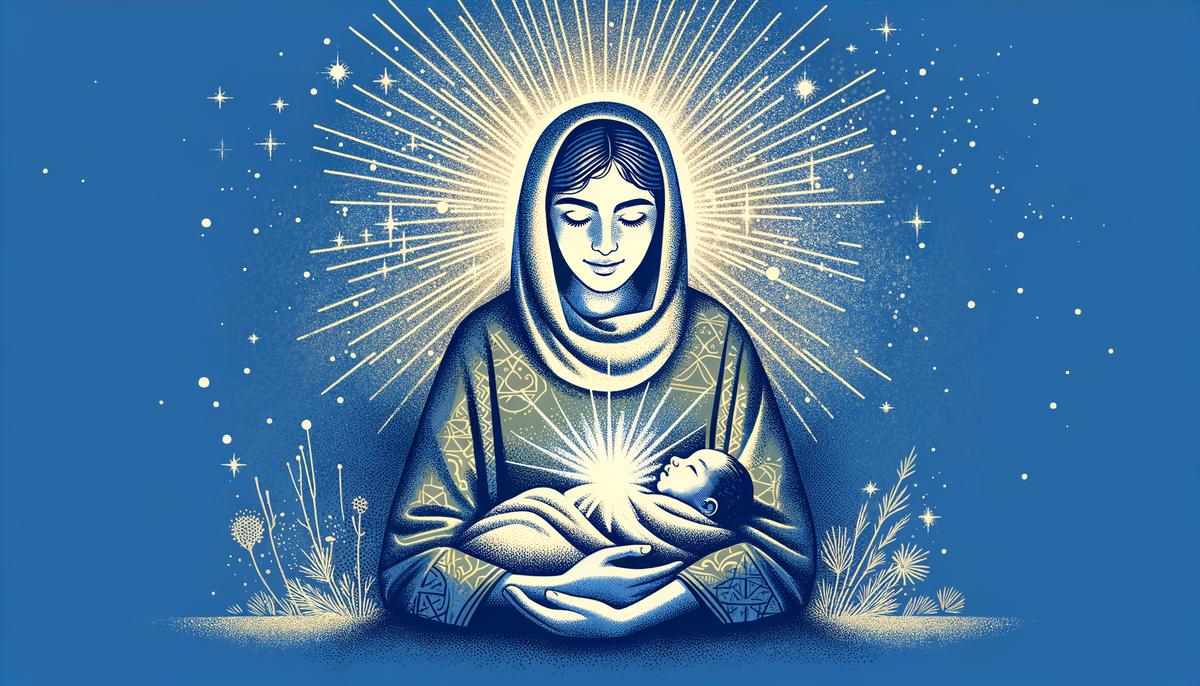
Contemporary Relevance of Isaiah 7:14
Isaiah 7:14 continues to offer hope and assurance to believers facing modern challenges. Just as it provided comfort in ancient times of political unrest, it speaks to those navigating today's uncertainties.
The promise of Immanuel – "God with us" – remains relevant, offering solace to those grappling with personal crises or global issues. It reminds believers of God's enduring presence and involvement in human affairs.
This prophecy encourages faith in God's larger plan, even when immediate circumstances seem daunting. It invites people to trust in divine promises and to see their lives as part of God's ongoing work of redemption.
For contemporary believers, Isaiah 7:14 is not merely historical but a living testament to God's faithfulness. It challenges them to look beyond immediate fears and to find hope in God's eternal perspective. The fulfillment of this prophecy in Jesus' birth continues to inspire trust in God's promises and His active presence in the world today.
The prophecy of Isaiah 7:14 stands as an enduring message of hope and divine assurance. It reminds us that even in uncertain times, God's promise of presence and redemption remains. This timeless truth invites us to trust in God's plan and find strength for life's journey.
- Oswalt JN. The Book of Isaiah: Chapters 1–9. Grand Rapids, MI: Eerdmans; 1986.
- France RT. The Gospel of Matthew. Grand Rapids, MI: Eerdmans; 2007.
- Waltke BK, et al. Theological Wordbook of the Old Testament. Chicago, IL: Moody Press; 1980.