
1. Setting the scene
Followers of Jesus have always lived with the tension that the Bible describes a world scarred by conflict even while calling God’s people to be peacemakers (Matthew 5:9). The fresh hostilities now erupting between Israel and Iran shock our hearts, yet they do not surprise Scripture, which depicts wars as recurring features of a fallen creation (Matthew 24:6). Instead of yielding to fear, we can turn to the Word for perspective, remembering that “the Most High rules in the kingdom of men” (Daniel 4:17).
2. Snapshot of the present conflict
Since mid-June 2025 Israel has carried out repeated strikes on Iran’s nuclear infrastructure at Natanz, Isfahan and the Khondab (Arak) heavy-water reactor. Iran has replied with waves of ballistic missiles and drones, one of which hit Soroka Medical Center in Beersheba and wounded hundreds. Casualty estimates already exceed 600 dead in Iran and dozens in Israel, and the United States is weighing direct involvement. reuters.comtheguardian.com
These facts remind us that the prophetic Scriptures speak to real nations and real bloodshed, not abstract ideas. Yet prophecy also pushes God’s people beyond headlines toward eternal purposes.
3. Israel and Persia in Scripture
Long before “Iran” existed, the Bible spoke of Persia—the ancient name for the same land. When Ezra returned from exile, a Persian king financed the rebuilding of the temple (Ezra 6:3-5). Later, hostile Persian officials opposed that work (Ezra 4:4-6). Scripture therefore presents Persia neither as perpetual enemy nor perpetual friend, but as a sovereign instrument in God’s hands (Isaiah 44:28).
That balanced picture guards us from demonizing an entire people today. The present regime’s actions do not erase the biblical truth that many Iranians, like many Israelis, are loved by God and part of His redemptive plan (Acts 10:34-35).
4. Ezekiel’s vision of a northern coalition (Ezekiel 38–39)
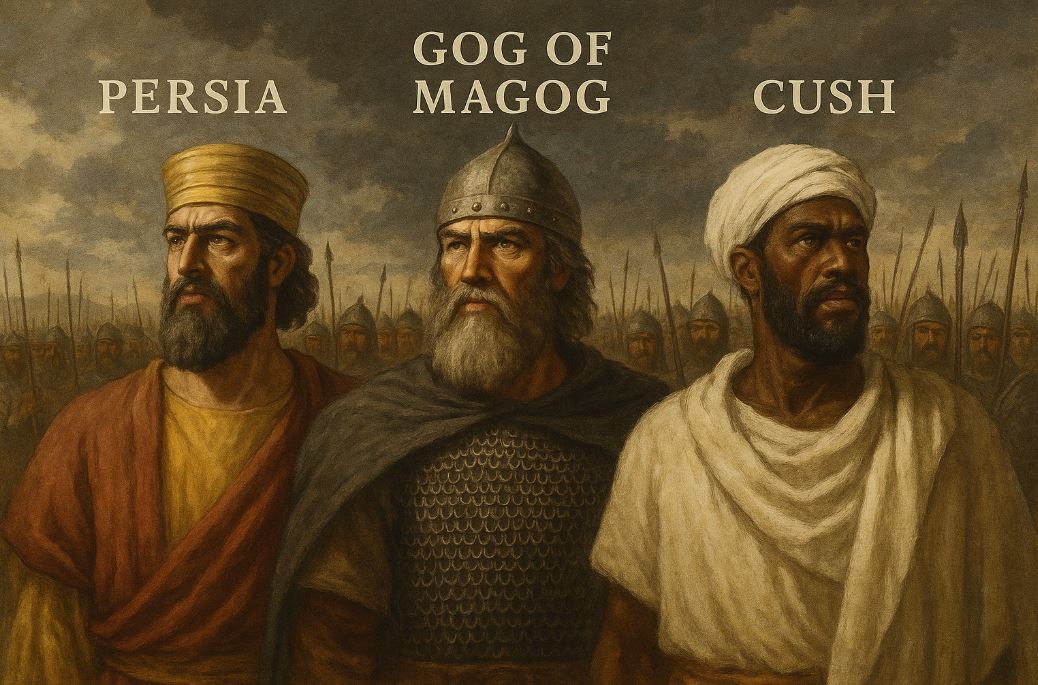
“Persia, Cush and Put will be with them…” (Ezekiel 38:5). Ezekiel foretells a future invasion led by “Gog of the land of Magog” against Israel at a time when the nation dwells “securely” (38:8). Scholars differ on Gog’s exact identity, yet Persia’s inclusion is indisputable.
Historical context. Ezekiel wrote c. 593-571 BC while exiled in Babylon. Israel lay desolate, making the notion of her later “regathering” astonishing. The prophecy thus had no plausible fulfillment in Ezekiel’s lifetime.
Key themes.
- Divine orchestration: God says, “I will bring you against My land” (38:16). Even hostile armies move only by divine permission.
- Universal recognition: The outcome is that “the nations shall know that I am the Lord” (38:23).
Parallels today. The present Israel-Iran war is not necessarily the Gog-Magog campaign, yet it underlines how swiftly Persia (Iran) can be drawn into actions that converge on Israel’s territory. The coalition Ezekiel names also includes “Gomer” and “Beth-togarmah” (commonly linked to regions of modern Turkey and the Caucasus), and many of those states have lately engaged diplomatically or militarily in the theatre. Such alignments illustrate how Ezekiel’s framework could materialize without forcing us to declare that it has done so. We watch prayerfully, not presumptuously.

5. Jerusalem in the prophets (Zechariah 12)
“I am making Jerusalem a cup that sends all the surrounding peoples reeling… On that day I will make Jerusalem an immovable rock for all the nations” (Zechariah 12:2-3). Written about 520 BC, Zechariah’s oracle envisions a siege where the nations gather but ultimately hurt themselves on the “rock” of God’s covenant city.
Modern resonance. Although the missiles now flying originate hundreds of miles east of Jerusalem, Israeli leaders repeatedly frame the contest with Iran as a fight for the capital’s survival. Tehran’s Revolutionary Guard rhetoric casts Israel’s seat of government as an illegitimate “Zionist entity.” Thus—even in an age of drones and cyber-war—the heart issue remains Jerusalem’s status, exactly as Zechariah foresaw.
Caution. The prophecy ends with Israel’s national repentance (12:10-13:1), something we have not yet seen in full. Any present-day echo therefore should stir intercession rather than triumphant prediction.
6. Spiritual forces behind nations (Daniel 10)
Daniel’s angelic visitor explains that “the prince of the kingdom of Persia resisted me twenty-one days… and now I must return to fight with the prince of Persia; and when I go forth, indeed the prince of Greece will come” (Daniel 10:13, 20). Scripture here pulls back the curtain to reveal unseen powers influencing earthly empires.
Application. Military analysts talk of radar coverage and missile ranges; believers also discern invisible battle lines. Behind both Jerusalem and Tehran stand spiritual agendas bigger than any government. This calls us to pray, for “the weapons of our warfare are not of the flesh” (2 Corinthians 10:4).
7. Sovereignty over kings and empires (Isaiah 45)
“Thus says the Lord to His anointed, to Cyrus, whose right hand I have held…” (Isaiah 45:1). The Lord names the Persian monarch Cyrus more than a century before his birth, prophesying that he will free Jewish exiles.
Reassurance. God can raise up—or restrain—any Iranian or Israeli leader today. Whether Ayatollahs or prime ministers, all sit beneath the same throne. Recognizing this removes the panic that often infects news cycles.

8. Wars and rumors of wars (Matthew 24)
Jesus warned, “You will hear of wars and rumors of wars… but see that you are not alarmed. Such things must happen, but the end is not yet” (Matthew 24:6-8). His words keep us from two errors: (1) apathy—thinking these events mean nothing; and (2) frenzy—assuming every conflict marks the final hour. They beckon us to readiness clothed in peace.
9. Drawing parallels
Similarities between Ezekiel’s coalition and current alliances are striking: Persia (Iran) is openly committed, while other regional players oscillate. Differences remain: Ezekiel describes Israel living “without walls,” enjoying a security that few Israelis would claim at this moment. Until prophecy aligns precisely, wise students hold possibilities with open hands.
Geopolitically, analysts note that Israel’s objective resembles the “Begin Doctrine” of pre-empting nuclear foes, now applied on a vastly larger scale. Iran’s reply illustrates its expanding missile reach and willingness to strike urban hospitals—acts the U.N. may judge as war crimes. reuters.com
Such realities illustrate biblical themes of nations raging while God sets boundaries (Psalm 2:1-6). They also demonstrate the prophetic pattern of preliminary foreshadows before ultimate fulfillment—just as Antiochus IV Epiphanes prefigured, but did not exhaust, Daniel’s “abomination of desolation.”
10. A call to prayerful response
Paul urges: “I exhort… that supplications, prayers, intercessions, and thanksgivings be made for all people, for kings and all who are in high positions” (1 Timothy 2:1-2). We therefore pray:
- For Iranian and Israeli civilians, that humanitarian corridors open and that God “defends the fatherless” (Psalm 82:3).
- For leaders on every side, that divine wisdom overrides pride, leading to de-escalation.
- For the global church, that we resist partisanship and love even our enemies (Matthew 5:44).
- For gospel witness among both Jews and Persians, many of whom secretly study the Scriptures despite government controls.
“If it is possible, as far as it depends on you, live at peace with everyone” (Romans 12:18). Believers can model cross-national friendship, share accurate information instead of sensational memes, and support relief efforts untainted by political agendas.

11. Conclusion
The Israel-Iran war confronts us with grim headlines and sobering prophecy. Ezekiel foresaw Persia’s future role; Zechariah highlighted Jerusalem’s centrality; Daniel exposed invisible powers; Isaiah affirmed God’s mastery over Persian kings; and Jesus assured us that wars do not overturn God’s timetable. Together these passages anchor us in hope rather than fear.
Every day of this conflict is one day closer to the moment when swords become plowshares (Isaiah 2:4). Until then, Scripture invites sober watchfulness, fervent prayer, and unswerving compassion for all caught in the crossfire. May we heed that call with a love “that does not delight in evil but rejoices with the truth” (1 Corinthians 13:6).