
Prophecy of the Star from Jacob
Numbers 24:17 describes a Star rising from Jacob, a powerful image that has captivated both Jewish and Christian traditions. For Jews, this celestial reference heralded a future ruler who would bring peace and justice, often envisioned as a king from Jacob's lineage. This prophecy sustained hope during times of turmoil and oppression.
Christians interpret this Star as a direct reference to Jesus of Nazareth, viewing it not just symbolically but as a literal sign guiding the wise men to the Messiah's birthplace. This interpretation sees ancient prophecies converging with the events surrounding Jesus' birth in Bethlehem.
Jewish interpretations traditionally focus on future redemption from earthly struggles, with the Messiah's arrival restoring Israel's glory. Christian views, however, see the prophecy fulfilled in Jesus, portraying him as a humble servant rather than a warrior, aligning with other prophecies like those in Isaiah about a suffering servant.
Thus, Numbers 24:17 became a focal point for diverse interpretations, each tradition finding unique yet overlapping meaning in its imagery.

Messianic Fulfillment in Jesus of Nazareth
The New Testament presents Jesus of Nazareth as the fulfillment of the ancient prophecy. In Matthew's Gospel, the Magi's journey, guided by a star, echoes Numbers 24:17. Their recognition of Jesus as the foretold Messiah marks a pivotal moment, blending scholarly pursuit with spiritual seeking.
In Revelation, Jesus is described as the "Bright and Morning Star" (Revelation 22:16), signaling a new covenant between God and humanity. This title extends His role beyond a historical event into an enduring legacy of divine redemption.
The birth account in Matthew illustrates a convergence of earthly events with heavenly signals, where the divine intersects human history. For believers, this symbolizes not just a historic event but a continual journey of faith.
These New Testament accounts affirm that in Jesus, the Messiah has come, presenting Him as a living testament to ancient promises and a source of hope for believers.
Astronomical and Historical Context
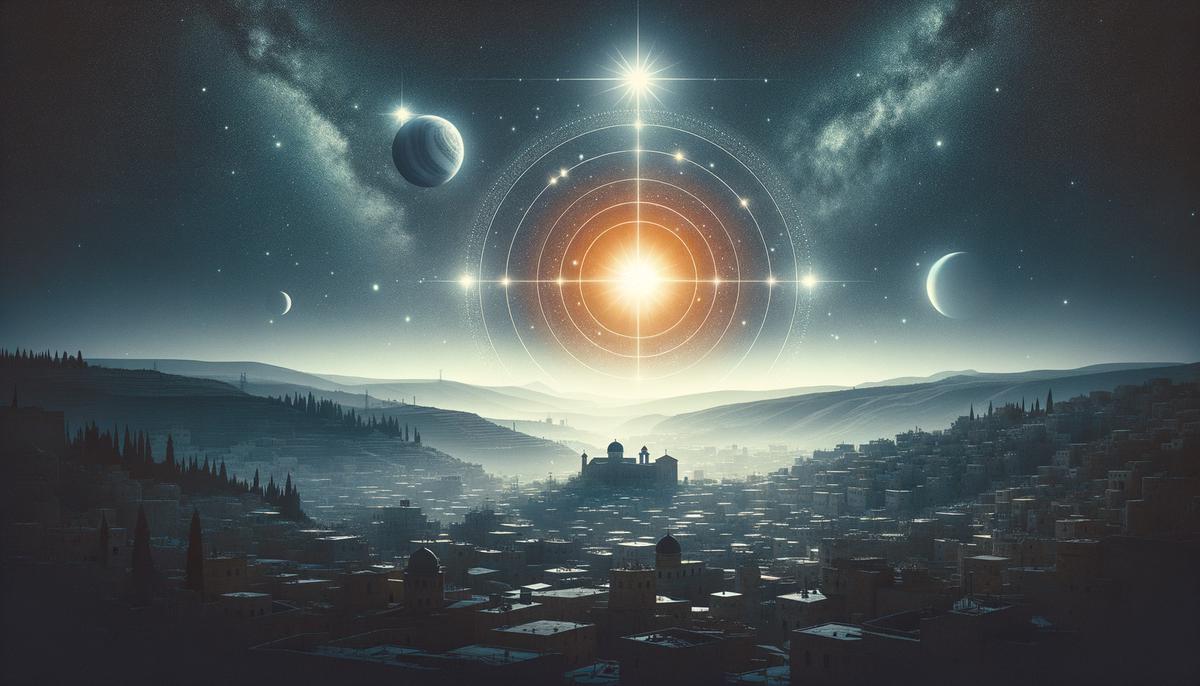
The Bethlehem Star phenomenon has intrigued both astronomers and theologians. Some scholars suggest it may have been a conjunction of planets, particularly Venus and Jupiter, which would have appeared as a brilliant star around 2-3 B.C. To the Magi, skilled in celestial observations, this spectacle in the constellation of Leo might have signified the birth of a great king.
This astronomical event coincided with significant historical developments, including:
- The reign of Herod the Great
- A Roman census that brought Mary and Joseph to Bethlehem
This convergence of celestial and earthly events aligns with the prophetic writings, suggesting a divine orchestration.
The celestial sign that guided the Magi bridges the spiritual promise with visible phenomena, reinforcing the belief that Jesus's birth was marked by both earthly and heavenly events. This interpretation continues to inspire wonder, challenging observers to consider these cosmic occurrences as more than mere astronomical marvels, but as divine signposts pointing to the fulfillment of ancient prophecies.
Messianic Expectations in Jewish Tradition
In Jewish tradition, the Messiah is anticipated as a future figure who will usher in an era of peace and justice, restoring Israel and renewing the world. Unlike the Christian view, which sees fulfillment in Jesus, Jewish tradition looks forward to a Redeemer who will lead both geopolitical and spiritual transformation.
Ancient Jewish texts often identify the Messiah as a descendant of King David, destined to reestablish Davidic sovereignty. The Dead Sea Scrolls suggest a Messiah who embodies both priestly and kingly roles, fulfilling divine purpose.
Modern Jewish scholars continue to explore these prophecies, maintaining a distinction between the longing for a Messiah and the focus on ethical living. This expectation differs significantly from Christian interpretation, focusing more on tangible peace and justice rather than spiritual salvation.
In both traditions, the imagery of the star from Jacob remains significant, inspiring contemplation on faith and divine plans. While interpretations diverge, the shared reverence for this prophetic vision continues to spark hope and reflection.
The Role of Prophecy in Messianic Belief
Prophecy is central to shaping messianic beliefs in both Jewish and Christian traditions. In Judaism, prophecies like Numbers 24:17 sustain hope for a future anointed leader who will restore Israel and bring universal peace. These visions have shaped cultural and religious ideas throughout history, reinforcing the expectation of a tangible, earthly redeemer.
Christian interpretations see these prophecies fulfilled in Jesus of Nazareth. For Christians, prophecies are viewed as divinely inspired revelations that both predicted and confirmed Jesus' identity and mission as the Messiah.
This divergence in interpretation underscores how prophecy serves different theological frameworks. In both faiths, prophecy:
- Anchors communities to their scriptural roots
- Shapes spiritual identity
- Offers a lens through which believers view their present circumstances and future hopes
By nurturing messianic belief, prophecy does more than predict—it shapes identity and challenges believers to reflect on spiritual truths. As faith communities engage with prophecy, they find not only direction but an invitation to participate actively in the unfolding of divine purpose.
The enduring hope and anticipation for a Messiah, inspired by the celestial imagery of a star rising from Jacob, continues to resonate deeply across traditions. This prophecy stands as a testament to faith's ability to transcend time, uniting believers in a shared journey toward divine understanding and redemption.
- Kushner H. The Messiah in Judaism. Jewish Theological Seminary. 2005.
- Josephus F. Antiquities of the Jews. Hendrickson Publishers; 1987.
- Dead Sea Scrolls: Texts and Commentary. Brill Academic Publishers; 2000.
- Philo of Alexandria. On the Life of Moses. Harvard University Press; 1935.
- Isaiah. The Holy Bible, New International Version. Zondervan; 2011.